
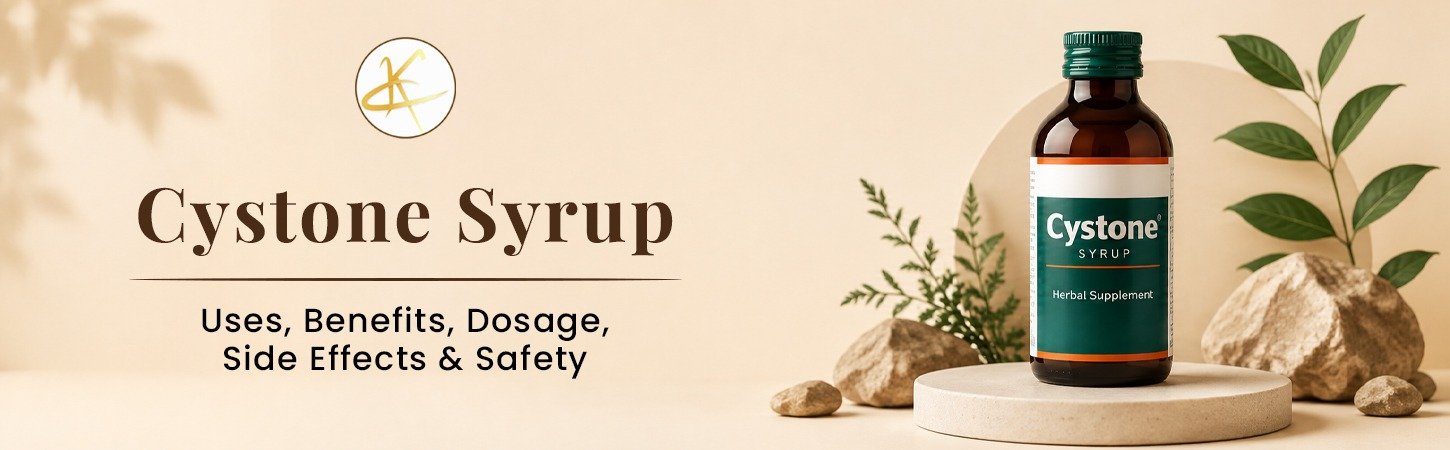
If someone in your family has used Cystone Syrup for kidney stones, you may be curious whether it would work the same way for your condition. Cystone Syrup uses are usually beneficial for urinary health, and knowing what it does helps set the right expectations from the start.
Cystone Syrup belongs to the Himalaya urinary-health category of Ayurvedic products. It comes up often in conversations around kidney stones, crystals in urine and urinary discomfort. Think of Himalaya Cystone Syrup’s role as supportive medication. It is not a substitute for medical evaluation, and the syrup shouldn’t be treated as a cure for every urinary condition.
Quick Answer: What Is Cystone Syrup Used For?
Urinary stones, crystals in the urine, and painful or burning urination are some common conditions that can be treated using Cystone Syrup. It helps relieve the pain and does not cure it. Thus, it works as a supplement, and doctors usually prescribe the syrup along with a diagnosis.
Cystone Syrup at a Glance
Wondering what Cystone Syrup really is? Let’s break it down into bite-sized facts you can scan in seconds.
| Question | Quick Information |
| What is it? | Ayurvedic urinary-health formulation |
| Brand | Himalaya Wellness |
| Main use area | Urinary tract health |
| Commonly associated with | Urinary stones, crystalluria and urinary discomfort |
| Key ingredients | Pasanabheda and Small Caltrops |
| Dosage | As directed by a physician |
| Important precaution | Complete ureteral obstruction |
| Form | Syrup |
What Are the Main Cystone Syrup Uses?
Himalaya Cystone Syrup uses are primarily geared towards treating and preventing kidney stones and Urinary Tract Infections (UTIs). It is made up of Pasanabheda and Small Caltrops (Gokshura) to maintain proper renal health. The following are some common uses of Cystone syrup:
1. Supportive Use in Kidney Stones
The anti-lithiatic properties of Cystone Syrup have effective antioxidant, litholytic and anti-mucus actions that help in the prevention and breaking up of renal stones. Doctors typically choose Cystone Syrup for kidney stones for monitoring of stone size, since the formulation supports elimination of smaller fragments.
2. Crystal Formation in the Urine (Crystalluria)
The term crystalluria is used to denote the presence of crystals in the urine. This is an indicator of stone formation. The syrup helps to reduce supersaturation of toxic components such as oxalic acid and calcium hydroxyproline. Using cystone syrup for crystals in urine works on this supersaturation stage specifically, before crystals may become larger stones in the kidneys.
3. Burning or Painful Urination
Due to the antiseptic and anti-inflammatory properties of Pasanabheda, this syrup from Himalaya has a soothing effect on burning urination. This syrup acts as an agent that helps balance the acid-alkaline ratio of the urine. As a result, it alleviates the burning sensation during urination. Cystone syrup for burning urination targets the irritation itself instead of an underlying infection, which is why persistent burning needs medical attention.
4. Burning or Painful Urination
The composition of this syrup includes herbs that have antimicrobial and anti-adhesive actions. Both of them prevent the formation of harmful bacteria and viruses in the urinary system. Cystone syrup for urinary tract health is used to maintain proper functioning of the kidneys, ureters and bladder together.
5. Support in Recurrent Cases of Urinary Stones
In recurrent cases of urinary stones or after lithotripsy, the syrup has preventive properties that reduce the chances of mineral depositions. Cystone syrup for urinary problems can also be used for recurring discomfort or repeated crystal formation, not just for stones themselves.
How Does Himalaya Cystone Syrup Work?
The working principle behind Himalaya Cystone Syrup is based on several properties attributed to its formulation. According to Himalaya’s product information, here is how the syrup works:
- Diuretic: Helps to urinate more frequently as well as pass small stones and gravel from the kidneys.
- pH normalising: This will help to balance the acidity of urine that can have an impact on the formation of stones and crystals.
- Antimicrobial: Works against common urinary tract pathogens to reduce microbial levels in the urinary tract.
- Anti-inflammatory: These cystone syrup benefits protect the irritated and inflamed internal tissues.
- Anti-adherent: Stops crystal-forming chemicals in urine from depositing and building up over time.
- Spasmolytic: Relaxes muscle spasms in the urinary tract that contribute to pain or discomfort.
What Are the Ingredients in Cystone Syrup?
The main ingredients of Cystone Syrup are Pasanabheda and Small Caltrops (Gokshura). Along with that, here is a quick look at more Cystone Syrup ingredients:
| Ingredient | Also Known As | What It Is Commonly Associated With? |
| Pasanabheda | Saxifraga ligulata | Diuretic and antimicrobial action to calm irritated urinary tissue |
| Punarnava | Boerhavia diffusa | Supporting kidney function and fluid excretion |
| Gokshura (Small Caltrops) | Tribulus terrestris | Assists in the functioning of the urinary tract and managing dysuria |
| Shilapushpa | Didymocarpus pedicellata | Antilithiatic and lithotriptic action linked to stone formation |
Can Cystone Syrup Dissolve Kidney Stones?
Cystone syrup helps in kidney pain relief, but it should not be assumed to dissolve every kidney stone condition. Whether a stone will pass on its own or require medical treatment depends on its size, type and location.
Why the Type of Kidney Stone Matters?
Familiarity with the types of kidney stones helps you know better how specific medication works on each condition. For example, calcium-based stones form when calcium binds with other minerals in your urine. It is not caused by eating excessive calcium. Instead, this condition occurs when you have less calcium.
Whereas uric acid stones develop when your urine accumulates excessive uric acid (a natural waste product of the body). Since both types of stones form in different ways, they are managed separately instead of following a single solution.
What the Evidence Says About Cystone?
Cystone has been studied in several clinical research studies. However, the findings have no stronger evidence for stone dissolution.
Brief evidence box: Manufacturer claims vs clinical evidence
A randomised, double-blinded crossover study has found no statistically significant effect of Cystone on urinary composition over either 6 or 52 weeks. The average renal stone burden increased instead of decreased during the study period.
Can Cystone Syrup Help With UTI?
Cystone cannot be used as a sole remedy to cure a UTI. Some people turn to Cystone syrup for UTI-like discomfort because the symptoms of urinary irritation and an actual bacterial infection can feel similar in the early stages. However, urinary irritation (discomfort, occasionally urgent urination) is not a UTI. It means that a bacterial infection is characterised by a burning sensation when urinating, turbid urine, fever and pelvic pain.
It is also important to note that Cystone Syrup is not an antibiotic. In case of a suspected bacterial infection, it is essential to diagnose it correctly by a doctor.
What Is the Recommended Cystone Syrup Dosage?
The present instructions for Himalaya India suggest the use of Cystone Syrup following the dosage recommended by a physician. If you ask how to use Cystone syrup correctly, the label itself does not specify a fixed measurement. It is important not to increase the amount even in case of severe symptoms. It will not lead to a faster effect and might cause an oversight of the symptoms requiring professional care.
Does Cystone Syrup Have Side Effects?
According to Himalaya, there have been no reports of significant Cystone syrup side effects or adverse events from using this syrup at the prescribed dose. This does not imply that all users react the same way because each person has individual sensitivities. In case any unusual symptoms occur during the intake of this syrup, stop taking it and consult a doctor.
Who Should Be Cautious Before Taking Cystone Syrup?
As per Himalaya, Cystone Syrup should not be taken in case of complete ureteral obstruction. Here are some general Cystone Syrup precautions you should know:
- Urinary obstruction is suspected: It is essential to consult a doctor in case of suspected obstruction because such cases must be managed directly by a clinician.
- Other medicines: People who are taking any other medication should be careful about any potential drug interactions with this syrup’s effects.
- Severe symptoms: Symptoms such as severe pain, high fever, and blood in the urine should be handled clinically.
- Pregnancy/breastfeeding: Women in these conditions should take this syrup after consulting a doctor.
Cystone Syrup vs Cystone Tablet: What Is the Difference?
The difference comes down to how that formulation is delivered into the body, and that changes how someone might use it day to day. The table below breaks down the key differences between Cystone Syrup vs Cystone Tablet:
| Factor | Cystone Syrup | Cystone Tablet |
| Form | Liquid | Tablet |
| Administration | Measured liquid dose | Tablet |
| Core purpose | Urinary health support | Urinary health support |
| Which should you choose? | Based on professional guidance | Based on professional guidance |
Both Cystone syrup and Cystone tablet are effective, and which one you should have depends on your preference and your doctor’s recommendation.
When Should You Seek Medical Advice?
You should seek medical attention if the pain does not fade away or you experience other symptoms as well. Here are some symptoms that you should not ignore:
- Severe or worsening side or back pain
- Fever or chills
- Blood in urine
- Vomiting
- Inability or difficulty passing urine
- Persistent urinary symptoms
- Recurrent stones
If any of these symptoms appear, you can consult Dr. Ankit Kayal, best urology doctor in Jaipur, who has over 20 years of experience in treating urological disorders and other related conditions. He has performed over 25,000 successful surgeries for treating conditions like kidney and urinary stone conditions as well as advanced prostate surgeries.
Expert Notes From Dr. Ankit Kayal
Cystone is frequently associated with treatments for kidney stones. Yet the use of Cystone works better as a support instead of a substitute for diagnosis and clinical assessment. There are several things to consider before using it, which are:
- Not every pain in the urinary tract means kidney stones.
- Each stone requires a unique approach depending on its size, location and composition.
- Cystone should not be used when symptoms are persistent or severe.
- For recurrent stones, understanding stone type and cause is more useful than repeatedly taking the same remedy.
Conclusion
Cystone Syrup is generally associated with supporting urinary health, including its traditional use around stones, crystalluria and dysuria. This support role does not mean every urinary problem can be managed at home. Used appropriately and alongside proper medical guidance, Cystone can play a supportive part in urinary wellness. If you have persistent or severe symptoms, then you need to consult a urologist.
Frequently Asked Questions About Cystone Syrup
1. What is Cystone Syrup used for?
Cystone Syrup is commonly linked with promoting urinary tract wellness, along with helping to keep the urinary pH in balance at adequate levels and also relieving symptoms such as dysuria (burning urination).
2. Is Cystone Syrup good for kidney stones?
Cystone Syrup is usually used for supportive treatment during urinary stones and crystalluria. The treatment of stones should be prescribed by a physician in accordance with the size and type of the stones.
3. Can Cystone Syrup dissolve kidney stones?
Cystone syrup is associated with relief from kidney stone conditions. But the effectiveness of the syrup for dissolving stones is limited. You should seek medical assistance for persistent or severe pain.
4. Does Cystone Syrup help with burning urination?
Yes, Cystone syrup can be used to relieve burning urination. In case of frequent burning during urination while using this medication, you should consult a urologist.
5. Is Cystone Syrup used for UTI?
Cystone is related to the general condition of the urinary system and can be used to relieve mild UTI.
6. Is Cystone Syrup an antibiotic?
No, Cystone Syrup is not an antibiotic.
7. What is the recommended dosage of Cystone Syrup?
The suggested product description by Himalaya India advises taking Cystone Syrup in accordance with the instructions of your physician.
8. Does Cystone Syrup have side effects?
There are limited known side effects associated with the syrup.
9. Can Cystone Syrup be taken daily?
Cystone can be taken as directed by a physician, usually over a period of time and not on a long-term basis.
10. Which is better, Cystone Syrup or Cystone Tablet?
No one form is proven to be more effective than another. The choice depends on individual preference and professional guidance.