
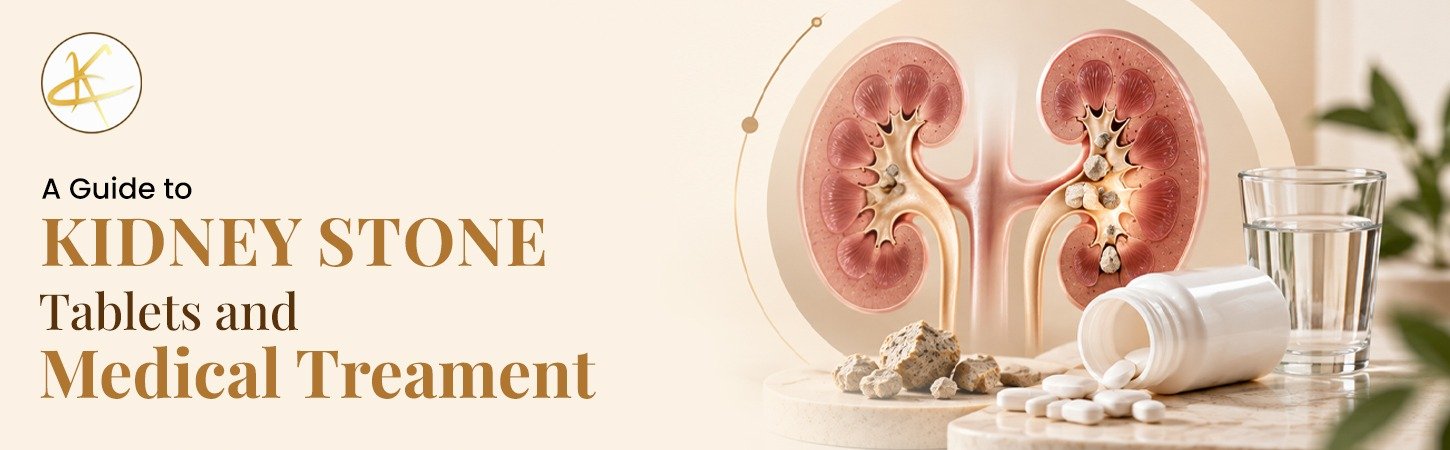
When a kidney stone strikes, the first thought for most of us is simple: Is there a tablet that will make it go away? It is a fair question, and one that fills search bars every day. But the truth is that all tablets for kidney stones are not suitable for everyone. What works depends on the stone’s type, size and location, and only uric acid stones can be completely dissolved with medicine. This guide explains which tablets ease pain, which help a stone pass and which lower the chance of new ones, along with herbal options and the safety rules worth knowing before you visit a chemist.
What Are the Best Tablets for Kidney Stones?
No single tablet works best for every kidney stone. Paracetamol or anti-inflammatory painkillers ease the pain. Tamsulosin may help small ureteric stones move out. Prescription medicines such as potassium citrate, thiazides or allopurinol lower the risk of new stones or dissolve uric acid stones. Your stone’s type, size and location decide the choice.
Seek urgent care if you have any of these:
- Fever or chills along with pain.
- Persistent vomiting that stops you from keeping fluids down.
- Severe pain that does not ease at all.
- Blood in the urine along with weakness or dizziness.
- Very little or no urine.
Kidney Stone Tablets at a Glance
Kidney stone tablets fall into a few clear groups, and each group has a different job. Look at the table below for an overview of the different types of tablets.
| Goal | Tablet class | Examples | Best for | Prescription? |
| Pain relief | Analgesics / NSAIDs | Paracetamol, ibuprofen, diclofenac | Symptom relief for all stones | OTC / Rx |
| Help stone pass | Alpha-blockers | Tamsulosin | Small lower ureteric stones | Rx |
| Prevent calcium stones | Thiazide diuretics | Hydrochlorothiazide, chlorthalidone | High urine calcium | Rx |
| Prevent / dissolve | Alkalinising agents | Potassium citrate | Uric acid (dissolves); calcium (prevents) | Rx |
| Lower uric acid | Xanthine oxidase inhibitors | Allopurinol | Uric acid stones, hyperuricosuria | Rx |
| Infection stones | Antibiotics/urease inhibitors | Acetohydroxamic acid | Struvite | Rx |
| Supportive | Polyherbal tablets | Cystone, sambong | Adjunct use, limited evidence | OTC |
Can Tablets Dissolve Kidney Stones?
Only uric acid stones can be reliably dissolved with medicine, and the usual choice is potassium citrate. Calcium stones, which make up most stones seen in patients, generally cannot be dissolved by any tablet. What tablets can do for them is help them pass or reduce the chance of new ones forming.
The table below shows how likely each common stone type is to dissolve with tablets:
| Stone type | Dissolves with tablets? |
| Uric acid | Yes |
| Cystine | Rarely |
| Struvite | Rarely |
| Calcium oxalate | No |
| Calcium phosphate | No |
Many websites promise that a capsule or syrup will “melt” every stone. Be cautious with such claims. Most of them stretch the evidence well beyond what studies show.
Tablets by Goal
Different tablets are made for different jobs. Some calm the pain, some relax the ureter so a stone can travel, some change your urine chemistry, and some deal with infection. Here is how each group works, and who it suits:
Tablets for Kidney Stone Pain
Renal colic is often described as one of the most intense pains a person can feel. Doctors usually start with anti-inflammatory painkillers because they work well for this type of pain. Paracetamol is a gentler option when NSAIDs are unsuitable, though it is usually less effective on its own.
- NSAIDs such as diclofenac or ibuprofen reduce inflammation and ureter spasm, which is why they often beat paracetamol for colic.
- Paracetamol suits people who cannot take NSAIDs, and it is usually the first step for mild pain.
- Stronger painkillers may be prescribed for a short spell when pain is severe, and only under medical supervision.
Some cautions matter here. NSAIDs can strain the kidneys, so anyone with existing kidney impairment should avoid them unless a doctor agrees. They can also irritate the stomach lining, so take them with food. In pregnancy, most NSAIDs are best avoided, and paracetamol is generally the safer starting point, again with medical advice.
Tablets That Help a Stone Pass (Medical Expulsive Therapy)
Medical expulsive therapy, often shortened to MET, uses medicines to make passing a stone easier. Tamsulosin, an alpha-blocker, and nifedipine, a calcium channel blocker, relax the muscle in the ureter wall. They do not shrink the stone. They simply widen the path and calm the spasms.
This approach is meant for stones in the ureter, usually up to about 10 mm, and it works best for stones in the lower part near the bladder. Small stones under 5 mm often pass by themselves within a few weeks. Larger ones between 5 and 10 mm may take longer, and some will need a procedure.
The evidence is mixed. Some trials show tamsulosin helps stones pass sooner, especially larger lower ureteric ones, while other large trials found little difference. So think of MET as an option your urologist may offer, and not a guaranteed fix.
Some points to keep in mind:
- Tamsulosin can cause dizziness, especially when you stand up quickly, so rise slowly.
- Nifedipine can lower blood pressure and cause headaches or ankle swelling.
- If a stone has not moved in about four weeks, or pain and infection develop, your doctor will usually suggest a procedure.
Tablets to Prevent Kidney Stones that Keep Coming Back
Once you have had one stone, the chance of another is high. Preventive tablets change your urine chemistry so that stones form less easily. The right one depends on what your stone is made of and what your urine tests show.
- Thiazide diuretics such as hydrochlorothiazide or chlorthalidone reduce calcium in the urine. They suit people with high urine calcium and calcium stones. Side effects can include low potassium, dizziness and increased urination.
- Potassium citrate raises urine pH and citrate, which blocks stone formation. It suits calcium stones with low citrate and uric acid stones. Side effects can include stomach upset, and it needs care in people with kidney disease or high potassium.
- Allopurinol lowers uric acid production. It suits uric acid stones and people with high urine uric acid. Rashes are the main side effect, and any new rash needs medical attention.
In randomised studies, citrate therapy reduced stone recurrence from about 65% to 46.5%. That is a meaningful drop, though it also means stones can still return, which is why fluids and diet matter alongside tablets.
Tablets for Infection Stones (Struvite)
Struvite stones form when certain bacteria make the urine alkaline. They can grow quickly and fill the kidney, sometimes forming what is called a staghorn stone. Antibiotics treat the infection, and acetohydroxamic acid, a urease inhibitor, can slow stone growth in selected cases.
Tablets rarely solve the problem alone. Surgical removal is usually central, because the stone itself harbours the bacteria and antibiotics fail to treat them. Medicines then help prevent the infection and stones from returning.
Which Tablet for Which Stone Type?
The right medicine follows the stone type. A stone analysis and a 24-hour urine test guide long-term prescribing, because they show what your stone is made of and which urine changes are driving it.
| Stone type | Common cause | Usual medicine | Key diet pairing |
| Calcium oxalate | High urine calcium or oxalate, low citrate | Thiazides, potassium citrate | Normal calcium intake, less salt, fewer high-oxalate foods |
| Calcium phosphate | Alkaline urine, high urine calcium | Thiazides, potassium citrate (used with care) | Less salt, adequate fluids |
| Uric acid | Acidic urine, high uric acid | Potassium citrate, allopurinol | Less animal protein, more fluids |
| Struvite | Urinary infection with urease bacteria | Antibiotics, acetohydroxamic acid | Plenty of fluids, treating infections early |
| Cystine | Inherited cystine leak into urine | Tiopronin, potassium citrate | High fluid intake, less salt |
Herbal and Ayurvedic Tablets for Kidney Stones
Many families reach for herbal options first, and that is understandable. These tablets for kidney stones are widely available and often contain natural compounds. Even so, they deserve the same careful thinking as any other medicine.
A Popular Polyherbal Option
Among herbal options, Himalaya Cystone is one of the most commonly used polyherbal tablets in India. You can read more about Cystone tablet uses, ingredients and dosage, but treat it as supportive care, not a replacement for medical treatment.
Ingredients and Claimed Actions
Polyherbal stone tablets usually combine several plants, each with a traditional claim. The list below covers the most common ones and what they are said to do.
- Shilapushpa is traditionally used to support urinary comfort.
- Pashanabheda, whose name means “stone breaker”, is traditionally linked to stone disintegration.
- Gokshura is traditionally used as a mild diuretic.
- Varuna is traditionally associated with urinary tract health.
These are traditional claims, and they do not prove that the tablet breaks up a stone in your kidney.
Evidence Check
The research is uneven. Sambong, a plant from the Philippines, has a systematic review cited in that country’s health technology assessment process. For most Indian polyherbal brands, the evidence is limited, and much of it comes from small studies.
Herbal Tablets Vs Prescription Tablets
| Factor | Herbal tablets | Prescription tablets |
| Evidence level | Limited to modest | Stronger, from larger trials |
| What it targets | General urinary support | Specific stone type or mechanism |
| Who should use it | Adults as an add-on, after medical advice | Anyone whose doctor prescribes it |
| Cautions | Quality varies, possible interactions | Side effects need monitoring |
Safe-Use Checklist
Before adding any herbal tablet to your routine, run through this list:
- Tell your doctor about every supplement you take.
- Avoid herbal stone tablets during pregnancy unless your doctor approves.
- Never stop a prescribed medicine because you have started a herbal one.
- Buy from a reputable brand and check the label for ingredients and dose.
- Stop and seek advice if you develop a rash, stomach pain or any unusual symptoms.
Tablets vs Other Treatments
Tablets are only one part of stone care. Larger stones, or stones that block urine flow, often need a procedure. The table below compares tablets with the main procedures by stone size, success rate, downtime and approximate cost in India.
| Option | Typical stone size | Success rate | Recovery Period | Approximate cost in India |
| Tablets (MET) | Up to about 10 mm, in the ureter | Varies; best for small lower ureteric stones | None | Low (medicine cost only) |
| ESWL | Up to about 20 mm | Roughly 30% to 90%, depending on size and position | Full recovery within 4 weeks | ₹45,000 to ₹60,000 |
| Ureteroscopy / RIRS | Up to about 20 mm | Roughly 85% to 90% | One-day procedure, Full recovery within 4 weeks | ₹90,000 to ₹1,30,000 |
| PCNL | Above 20 mm | 75% to 98% | 2 to 4 weeks for full recovery | ₹85,000 to ₹98,200 |
Costs vary by city, hospital and insurance cover, so treat these as rough guides and confirm with your hospital.
When Tablets Are Enough
Tablets and watchful waiting are suitable for stones that are small, cause manageable pain and are not blocking the kidney. Your doctor will usually confirm this with a scan and a urine test before suggesting this route.
The points below cover when a tablet-first approach makes sense:
- The stone is small, usually under 5 mm, and located in the lower ureter.
- Pain is controlled with medicines, and you can drink and eat normally.
- There is no fever, infection or sign of kidney damage.
- Follow-up scans show the stone moving down.
ESWL
Extracorporeal shock wave lithotripsy, or ESWL, uses focused shock waves from outside the body to break a stone into fine fragments that you then pass in the urine. It needs no cut, and most people go home the same day. It works best for stones up to about 20 mm in the kidney or upper ureter.
Very hard stones, such as some calcium oxalate monohydrate or cystine stones, may respond poorly, and more than one session is sometimes needed. Passing the fragments can cause colicky pain for a few days.
Ureteroscopy and RIRS
In ureteroscopy, a thin scope travels through the urinary passage to reach the stone, which is then broken with a laser and removed. Retrograde intrarenal surgery, or RIRS, uses a flexible scope to reach stones inside the kidney.
Success rates are high, and clearing the stone in one sitting is a big advantage. A small tube called a DJ stent is often placed for a short period to help with healing, and it can cause mild burning or urgency until it is removed.
PCNL
Percutaneous nephrolithotomy, or PCNL, is used for large or complex stones, generally above 20 mm, including staghorn stones. The surgeon makes a small opening in the back and removes or breaks the stone directly. It needs a hospital stay of a few days, but it clears large stones far more effectively than other methods. Your doctor may also suggest it when other treatments have failed.
How Doctors Choose the Right Option
Doctors weigh several factors together and do not decide on stone size alone. Here is what usually shapes the choice.
- Stone size, number and position in the urinary tract.
- Stone hardness, which a CT scan can help estimate.
- Signs of infection or a blocked kidney, which need urgent drainage.
- Your age, other health conditions and any blood-thinning medicines.
- Pregnancy, which limits several options.
- Your budget, insurance cover and time away from work.
Even after a procedure, tablets, fluids and diet changes still matter. They lower the chance of new stones and protect your kidneys in the long run.
Who Should Not Self-Medicate?
Kidney stone tablets can look harmless, but some groups face real risks when they treat themselves. The points below cover who should always get medical advice first:
- Patients with kidney impairment: Painkillers and some stone medicines can harm weakened kidneys.
- Pregnant women: Many stone medicines are unsuitable, so every tablet needs a doctor’s approval.
- Elderly patients: They are more prone to dizziness, falls and kidney strain.
- Gout patients: It changes how uric acid is handled, so the medicine choice needs care.
- People with heart diseases: Some tablets affect blood pressure or fluid balance.
- People who take blood pressure medicines: Tamsulosin and nifedipine can add to their effect and lower pressure too far.
Two risks deserve special mention. Regular NSAID use can damage the kidneys, especially when you are dehydrated. Potassium citrate can raise blood potassium, which is dangerous for people with kidney disease or those on certain BP tablets.
Here are the warning signs that need urgent care:
- Fever with pain.
- Persistent vomiting.
- Severe pain that does not settle.
- Blood in the urine with weakness.
- Very little urine.
Expert Tips
Urologists share a handful of habits that make treatment work better. Here is what they most often recommend:
- Get a stone analysis and a 24-hour urine test before starting long-term prevention, so the medicine matches the cause.
- Strain your urine and keep any stone that passes, then take it to the lab for testing.
- Keep dietary calcium at a normal level, and cut back on sodium and animal protein.
- Aim for at least 2.5 litres of urine a day. Kidney-friendly drinks such as lemon water can help you reach that goal.
Diet and Lifestyle Alongside Tablets
Tablets do their best work when daily habits back them up. Food, fluids and routine decide how much of the benefit you keep. The subsections below cover what matters most.
Hydration Habits
Water keeps urine dilute, which gives crystals less chance to form. Sip steadily through the day and aim for pale straw-coloured urine.
The points below cover practical ways to stay on track:
- Keep a bottle within reach at your desk, in the car and at home.
- Drink more in hot weather or after heavy sweating.
- Aim for at least 2.5 litres of urine a day, as your doctor advises.
If you want ideas, our guide to kidney detox drinks for stone prevention covers which ones have real support and which are hype.
Salt, Calcium and Oxalate
Too much salt pushes more calcium into your urine, while too little dietary calcium lets more oxalate reach the kidneys. Getting this right matters more than any single food swap.
This list explains what to do:
- Cut back on salt, including pickles, papad, namkeen and packaged snacks.
- Keep calcium normal through milk, curd and paneer.
- Eat spinach, beetroot and nuts in moderate portions instead of avoiding them.
Protein and Supplements
Heavy meat intake raises uric acid and lowers urine citrate, and both favour stones. Supplements can also add risk without you noticing.
Here is what to keep in mind:
- Keep portions of eggs, chicken and mutton sensible, and let dals share the load.
- Avoid high-dose vitamin C and calcium tablets unless your doctor recommends them.
Everyday Lifestyle Habits
Small routines support your treatment:
- Maintain a healthy weight and stay active.
- Take your tablets at the same time each day.
- Attend follow-up tests so changes are caught early.
When to See a Doctor and What to Ask
Kidney stones might not show symptoms for months. But patients might start experiencing sudden, severe pain, and early medical advice often prevents a small problem from turning into a blocked kidney or an infection. Knowing when to book a consultation and what to ask once you are there helps you get the most from the visit.
The list below covers the symptoms that call for a consultation:
- Pain in the side or lower back that comes in waves and may travel towards the groin or lower abdomen.
- Blood in the urine, even if it comes and goes or urine that looks pink, red or brown.
- Burning or urgency when passing urine, which can point to an infection alongside the stone.
- Nausea or vomiting that comes with the pain.
- A stone that has not passed after a few weeks of waiting and medical treatment.
- A history of stones, so you can discuss prevention before another one forms.
If you also have fever, chills, severe pain that does not ease or very little urine, do not wait for an appointment. Go to the nearest emergency department.
A few well-chosen questions can make your appointment far more useful. The list below covers what to ask your doctor:
- What is the size and location of my stone, and can it pass on its own?
- Which tablets do you recommend for pain and for helping the stone pass, and for how long?
- Should I get a stone analysis and a 24-hour urine test to guide prevention?
- Which foods and drinks should I limit or increase in my daily routine?
- Are any of my current medicines, including BP tablets or supplements, likely to affect my stones?
- How soon should I come back for a follow-up scan or test?
- Which signs mean I should return earlier or seek emergency care?
Bring a list of all the medicines and supplements you take, along with any earlier scan or test reports. This helps your doctor choose the safest treatment and avoid repeating tests.
FAQs
Which tablet is best for kidney stone pain?
NSAIDs such as diclofenac often work best for colic, while paracetamol suits people who cannot take them. Your doctor will choose based on your kidney health and other conditions.
Can tablets dissolve kidney stones?
Only uric acid stones can be dissolved reliably, usually with potassium citrate. Calcium stones do not dissolve with tablets.
Does tamsulosin help pass kidney stones, and how long does it take?
It may help small lower ureteric stones pass by relaxing the ureter, though studies show mixed results. Passage often takes a few weeks, and your doctor will review progress.
Can I take ibuprofen with a kidney stone?
Often yes, for short-term pain relief, if your kidneys are healthy and you have no stomach problems. Check with a doctor first if you have kidney disease, are pregnant or take BP medicines.
Which tablet is used for uric acid stones?
Potassium citrate is the main choice, as it makes urine less acidic and helps dissolve the stone. Allopurinol may be added when uric acid levels are high.
How long should I take potassium citrate?
Duration depends on your stone type and urine tests, and it can range from months to long-term use. Your doctor will adjust it based on follow-up results.
What are the side effects of kidney stone tablets?
Common ones include stomach upset, dizziness, headaches and, with some medicines, rashes or changes in potassium. Report anything unusual to your doctor.
Are kidney stone tablets safe in pregnancy?
Many are not, so never start one without medical advice. Paracetamol is generally the safer painkiller, and other treatments need specialist guidance.
What size stone can pass with tablets alone?
Stones under 5 mm often pass on their own, and some between 5 and 10 mm may pass with medical help. Stones above 10 mm rarely pass without a procedure.
Can stones come back after taking medicine?
Yes, they can, even with treatment. Preventive tablets, plenty of fluids and diet changes lower the risk but do not remove it.
Do I need a prescription for kidney stone medicine?
Basic painkillers and some herbal tablets are sold over the counter. But alpha-blockers, thiazides, potassium citrate and allopurinol need a prescription.